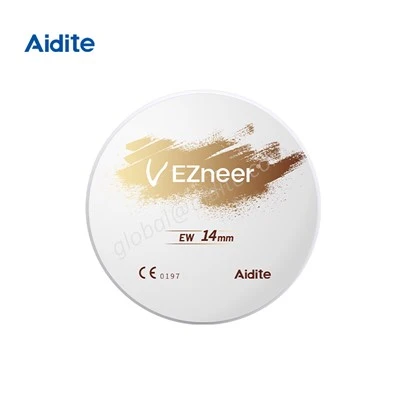
The manufacturing process of a 3D Multilayer Zirconia Block is a sophisticated and intricate procedure that combines advanced technology with precise craftsmanship. As a leading supplier of 3D Multilayer Zirconia Block, I am excited to share the details of this remarkable process.
1. Raw Material Selection
The first step in manufacturing a 3D Multilayer Zirconia Block is the careful selection of raw materials. Zirconia, a ceramic material known for its high strength, durability, and biocompatibility, is the primary component. The purity of zirconia powder is of utmost importance, as it directly affects the final properties of the block. High - purity zirconia powder with a specific grain size distribution is chosen to ensure optimal performance.
In addition to zirconia, stabilizers such as yttria are added to the powder. Yttria helps to stabilize the crystal structure of zirconia, preventing it from undergoing phase transformation at different temperatures. This is crucial for maintaining the strength and stability of the final product. The ratio of zirconia to stabilizers is precisely controlled to achieve the desired material properties.
2. Powder Preparation
Once the raw materials are selected, the zirconia powder and stabilizers are mixed together. This mixing process is done using high - energy ball milling or other advanced mixing techniques. The goal is to ensure a homogeneous distribution of the stabilizers within the zirconia powder.
During ball milling, the powder is placed in a container along with grinding balls. The container is then rotated, causing the balls to collide with the powder particles. This collision breaks down the powder particles and promotes the mixing of the components. The milling time and speed are carefully adjusted to achieve the desired particle size and degree of mixing.
After milling, the powder is often subjected to a granulation process. Granulation helps to improve the flowability of the powder, making it easier to handle during the subsequent shaping steps. There are several granulation methods available, such as spray drying. In spray drying, the milled powder is dispersed in a liquid medium and then sprayed into a hot chamber. The liquid evaporates, leaving behind spherical granules of the powder.
3. Layer Formation
One of the distinctive features of a 3D Multilayer Zirconia Block is its multiple layers, which mimic the natural appearance of teeth. To create these layers, different colored zirconia powders are used. The colored powders are prepared by adding specific pigments to the base zirconia powder.
The layer formation process can be achieved through a variety of methods. One common approach is the tape casting method. In tape casting, a slurry of the zirconia powder and a binder is prepared. The slurry is then spread onto a flat surface using a doctor blade to form a thin layer. The thickness of the layer can be controlled by adjusting the gap of the doctor blade.
After the first layer is cast, it is allowed to dry partially. Then, a second layer of a different colored slurry is cast on top of the first layer. This process is repeated for each layer, depending on the desired number of layers in the 3D Multilayer Zirconia Block. The drying time between layers is carefully controlled to ensure good adhesion between the layers.
Another method for layer formation is the hot isostatic pressing (HIP) additive manufacturing technique. In this method, thin layers of zirconia powder are selectively sintered using a high - energy source, such as a laser. The laser melts and fuses the powder particles together to form a solid layer. After each layer is formed, another layer of powder is added, and the process is repeated to build the 3D structure of the block.
4. Green Body Shaping
The layers of zirconia powder are then shaped into the desired block size and shape. This is known as the green body shaping process. The green body is the un - sintered form of the zirconia block. There are several shaping methods available, including isostatic pressing and injection molding.
Isostatic pressing involves placing the green body in a flexible mold and then subjecting it to uniform pressure from all directions. This pressure helps to compact the powder particles, increasing the density of the green body and improving its mechanical strength. The pressure is typically applied using a hydraulic press or a gas - filled chamber.
Injection molding is another popular method for shaping the green body. In injection molding, the zirconia powder is mixed with a polymer binder to form a moldable compound. The compound is then injected into a mold cavity under high pressure. The shape of the mold cavity determines the final shape of the green body. After injection, the green body is removed from the mold and the binder is removed through a process called debinding.
5. Debinding
Debinding is a critical step in the manufacturing process. The purpose of debinding is to remove the binder that was added to the zirconia powder during the shaping process. If the binder is not completely removed, it can cause defects in the final product, such as cracking or porosity.
There are two main types of debinding methods: thermal debinding and solvent debinding. Thermal debinding involves heating the green body in a furnace at a controlled rate. As the temperature increases, the binder decomposes and is removed from the green body in the form of gases. Solvent debinding, on the other hand, involves immersing the green body in a solvent that dissolves the binder. After solvent debinding, the green body is usually subjected to a thermal treatment to remove any remaining solvent and to further strengthen the structure.
6. Sintering
Sintering is the process of heating the debound green body to a high temperature to densify the zirconia and improve its mechanical properties. During sintering, the zirconia powder particles fuse together, eliminating the pores between them. This results in a dense and strong ceramic material.
The sintering process is typically carried out in a high - temperature furnace. The temperature and time of sintering are carefully controlled to achieve the desired density and grain size of the zirconia. For 3D Multilayer Zirconia Blocks, a two - step sintering process may be used. The first step is a pre - sintering process at a relatively low temperature to remove any remaining impurities and to start the densification process. The second step is a final sintering process at a higher temperature to achieve full densification.
7. Quality Control and Finishing
After sintering, the 3D Multilayer Zirconia Block undergoes a series of quality control tests. These tests include dimensional inspection, hardness testing, and color matching. Dimensional inspection ensures that the block meets the specified size and shape requirements. Hardness testing verifies the mechanical strength of the block. Color matching is crucial to ensure that the block's color closely resembles the natural tooth color.
If any defects are found during the quality control process, the block may be re - worked or discarded. For blocks that pass the quality control tests, the final step is finishing. Finishing operations may include grinding, polishing, and surface treatment to achieve a smooth and aesthetically pleasing surface.


8. Applications and Advantages in the Dental Industry
3D Multilayer Zirconia Blocks are widely used in the dental industry for the fabrication of dental restorations, such as crowns, bridges, and implant abutments. The multilayer structure of the block provides a more natural and realistic appearance compared to traditional single - layer zirconia blocks.
Compared to other dental materials, such as Pre Shaded Zirconia Blocks, Dental Implant Zirconia Block, Dental Zirconia Ceramic Blocks, and Ultra Translucent Zirconia, 3D Multilayer Zirconia Blocks offer improved aesthetics and strength. The high strength of zirconia makes it suitable for long - term use in the oral cavity, while the natural - looking layers enhance the patient's smile.
Contact for Purchase
If you are interested in purchasing high - quality 3D Multilayer Zirconia Blocks, please feel free to contact us for further details. We are committed to providing the best products and services to meet your dental material needs. Our team of experts is ready to assist you in choosing the right product for your specific applications.
References
- Stark, R. M., & Woll Stanley, R. R. (2001). The use of zirconia for fixed prosthodontics. Quintessence International, 32(1), 27 - 36.
- Kelly, J. R., & Denry, I. (2008). Dental ceramics: historical perspective, current status, and future research. Dental Materials, 24(11), 1623 - 1634.
- Zhang, Y., & Luo, Y. (2015). Advances in dental zirconia ceramics. Journal of Dental Research, 94(11), 1444 - 1452.